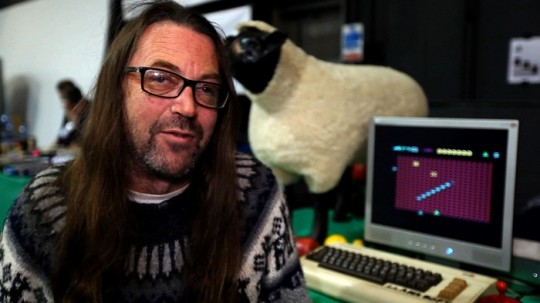
Jeff Minter on a scene from the documentary film ‘From Bedrooms to Millions’
Jeff Minter started developing videogames in 1981 and has not stopped doing it since. From Llamasoft he’s defined the psychedelic shoot’em up as a genre on its own, from Tempest 2000 for Atari Jaguar to «love-it-or-hate-it» Space Giraffe for Xbox Live. After some years developing mostly for iOS platforms, TxK for Vita represents his comeback to the console scene, and it is a glorious one. We had a chance to get to know him better through a brief Q&A and this is the result.
First of all, about this new game: how do you make it perfect for a five minute break and impossible to leave after one straight hour? I’ve been experiencing it both ways and I always find it worthy of my time and effort, be it three minutes or thirty. Which is great and horrible at the same time, since I can carry it around wherever I want. You seem to take the players pretty seriously about their lifestyle and available time.
I’ve found when I am playing myself that sometimes you want a good long session and sometimes you don’t have time for that and just want to dip in for a quick go. That’s what led to the Restart Best system which we’ve been refining for a few games now. With Restart Best you build up a kind of «best lives and score» profile over the whole game, and for a quick go you can just go to any level and try to improve your best there, whereas for a longer game you can settle in for a Pure Mode score starting at level 1. Players seem to enjoy it since it gives them both short and long ways to play to fit in with their circumstances. I think this is particularly important on mobile devices, where you may be on a train for 4 hours, or on the Tube for 10 minutes.
You have created great titles on almost any type of videogame device standards, from early Atari to touch screen devices and back to the physical interface throught iCade control support. Your thoughts on hardware limits and developing Tempest versions along the years are fascinating. What’s so special about the Vita hardware, and what’s the next limit to push?
What I like about the Vita as a platform is: great screen, very capable GPU, and great controls. Working on phones and tablets is OK but you always have to implement touch controls, and although I did get quite good at making those not too horrible, you can’t beat a proper set of sticks and buttons. Also in the tablet/phone market you have to deal with a broad range of CPU/GPU standards, screen sizes etc. The Vita is a known quantity with an excellent GPU so you can work to its strengths when you are designing a game for it.
We’re very pleased that our first game on Vita has come out so nicely and we’ve got some cool ideas as to where we want to head to next.
Digital distribution has brought together a so-called democracy among developers, but app stores have become a very aggresive territory, continuosly demanding for cheap clones, fast time to market and price drops. However, Llamasoft’s games are a kind of their own on terms of excellence, testing before release and even pricing. What’s the «good» lesson to learn from Apple’s digital store policy? And most importantly, when will this freemium frenzy end?
Regarding the app stores, at the moment I do not think they are a particularly healthy place for someone like me to be. We spent a couple of years working on iOS games and although all of them got good reviews from press and users (all of them have app store ratings between 4 and 5 stars) it actually ended up costing us money. The app store is too full of noise and now people don’t even expect to pay for games any more, which created «free to play» and «freemium», and companies scrambling to clone the latest flash in the pan game. I’m sure there’s money to be made doing that but I would rather concentrate on trying to make good games that I feel good about and that people can buy outright than get involved with all that F2P stuff. I feel much more comfortable to be on PSN where maybe the barrier to entry is a little bit higher but in the end people actually don’t mind paying a fiver for a game instead of expecting it for 69p or for nothing (with loads of ads and/or IAPs).
I don’t think it is impossible to do F2P well but I think it «is» difficult to do it well, and it’s difficult enough to design a decent game in the first place, so games with non-offensive F2P that are also actually good games are going to be quite a rarity. I hope that side of the market will eventually sort itself out, and players will learn to say no to crappy F2P implementations. And I hope that there will still remain a non F2P model for those of us who want to create and sell games that are complete entities that people can buy and own outright.
Just to end this brief Q&A: Is there any game keeping you busy while you’re not at work lately?
As for what I’m playing at the moment when I am not working – I have a playthrough of Skyrim going on on my PC (I installed a mod which gives me a minotaur companion) and for quick sessions with lots of swearing I have Spelunky on my Vita. I die a lot in Spelunky but some of the deaths are so violent and funny you can’t help but laugh.
Desde mi punto de vista los f2p son lo peor que le ha pasado a esta industria y sobre todo a los jugadores que disfrutamos con algo más que el Candy mierda de turno.